Estate insights — "What data do we have?"
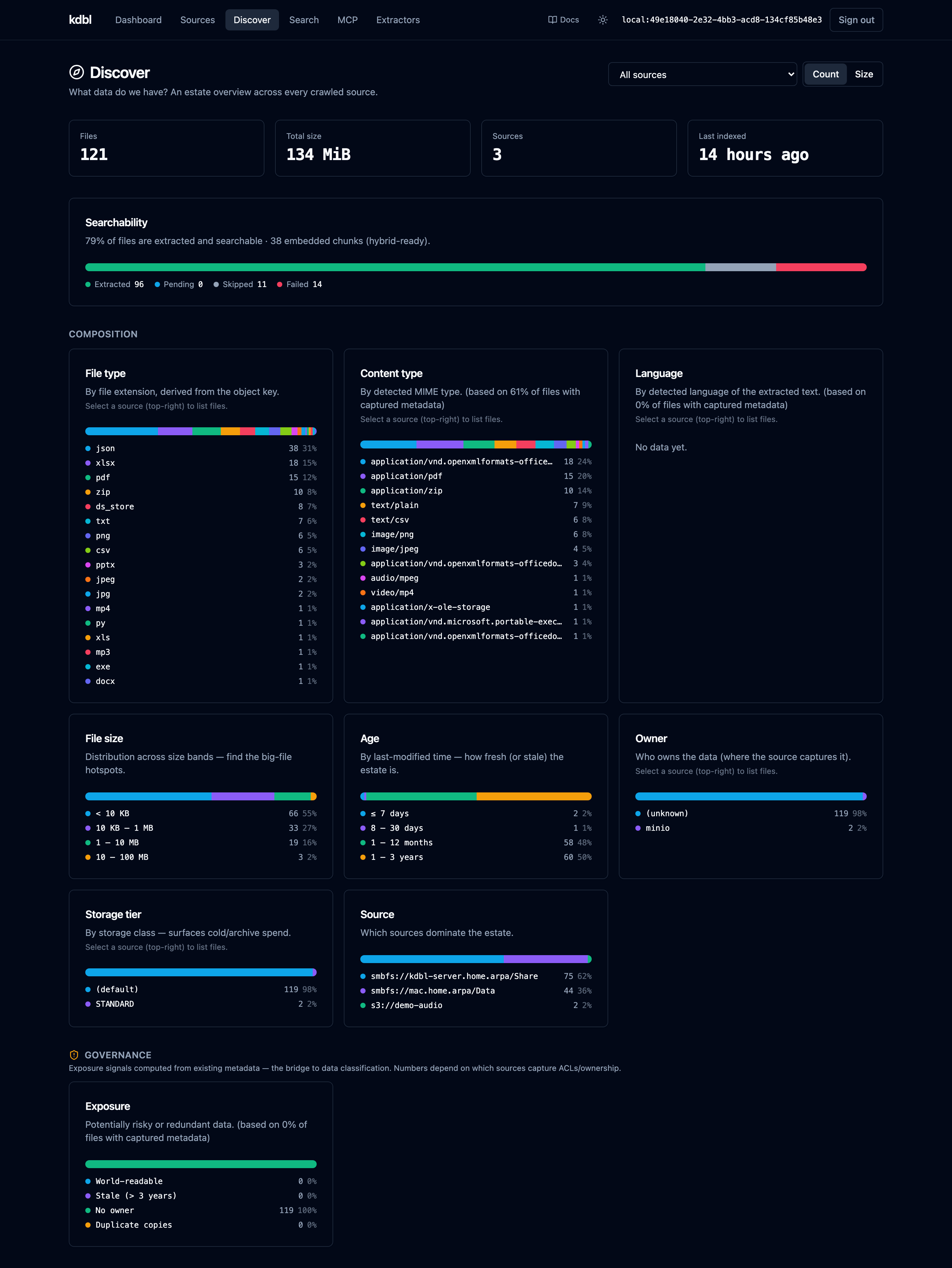
Estate insights (called Discover in earlier releases) is a data-estate overview: a single tenant-admin page, Data › Estate insights in the console sidebar (or press ⌘K / Ctrl+K and type insights), that turns everything K-Lake has crawled and extracted into an answer to the governance question every organisation eventually asks — what data do we actually have, where does it live, how old is it, how much is searchable, and how exposed is it?
It reads the metadata and extraction results K-Lake already holds — no re-crawl, no extra configuration — and aggregates them live into tiles, composition breakdowns, and a governance view.
Access. Estate insights is tenant-admin only — its aggregates span every source in the tenant, so it isn't per-user access-trimmed the way search is. A non-admin token is refused. Cluster admins can get a cross-tenant roll-up (see Cross-tenant).
What it shows
Overview tiles
Top-line totals for the whole tenant (or one source, chosen in the source filter at the top, which defaults to All sources): files, total size, number of sources, and last indexed time.
Searchability
How much of the estate is actually searchable: the share of files extracted OK, plus pending / skipped / failed counts and the number of embedded chunks (hybrid-ready). This is the fastest way to spot a source that was crawled but never extracted.
Composition
Each dimension is a breakdown bar + top-N table. Toggle the whole page between ranking by file count and by total size with the Measure by switch (Count / Size).
| Dimension | Answers |
|---|---|
| File type | What file extensions dominate (derived from the object key). |
| Content type | MIME composition (from captured metadata). |
| Language | Detected language of the extracted text. |
| File size | Distribution across size bands — find the big-file hotspots. |
| Age | Distribution by last-modified time — how fresh (or stale) the estate is. |
| Owner | Who owns the data (where the source captures ownership). |
| Storage tier | Storage class — surfaces cold / archive spend. |
| Source | Which sources dominate the estate. |
Governance — exposure signals
A governance view computed from metadata that already exists. For sensitivity levels and labels read from the documents' content, see Data classification. The Exposure breakdown surfaces potentially risky or redundant data:
- World-readable — files whose captured ACLs grant everyone read.
- Stale (> 3 years) — not modified in over three years (ROT candidates).
- No owner — no ownership captured.
- Duplicate copies — files that appear to be duplicated (matching content hash).
Coverage is reported honestly. Content-type, language, and the exposure signals depend on metadata the source actually captured. Where a facet is based on a subset of files, the card says so ("based on N% of files with captured metadata") rather than presenting a partial number as ground truth. To raise coverage, enable the relevant metadata caps (e.g. NTFS/NFSv4 ACLs for exposure) and re-crawl.
Drill down to the files
Click a bar in an equality-shaped breakdown — file type, content type, owner, storage tier, or language — to list the actual files behind it (scoped to a source). This is the payoff: go from "12% of the estate is PDFs" straight to the PDFs themselves. (Size, age, source, and exposure are summaries only, not drill-through.)
Beyond the console — CLI & AI
Estate insights is available on three surfaces, all from the same aggregates.
CLI
kdbl-control discover prints the raw JSON (ideal for scripting or piping to
jq). Requires API mode (--api-url / --api-token, or KDBL_API_URL /
KDBL_API_TOKEN).
# Estate overview
kdbl-control --api-url "$KDBL_URL" --api-token "$KDBL_TOKEN" discover overview

# A breakdown by a dimension (rank by files [default] or bytes)
kdbl-control ... discover breakdown extension
kdbl-control ... discover breakdown size --metric bytes --limit 10

# The files behind one bucket (source, dimension, value)
kdbl-control ... discover files 's3://docs-bucket' extension pdf
breakdown takes a dimension (extension | mime | language | size | age | owner
| storage_class | source | exposure) plus optional --source, --metric
{files|bytes}, and --limit (max 100). files takes <source> <dimension>
<value> and pages with --limit (max 1000) / --after <cursor>.
AI assistants (MCP)
An MCP tool — data_estate_summary — gives an AI assistant the same
whole-estate overview so it can orient before searching ("what kinds of
documents exist, how much, how fresh, how much is searchable, which sources
dominate, what languages are present"), then target
search_content
intelligently. It's tenant-admin scoped like the console page. See
MCP skills.
REST API
GET /api/discover/overview, GET /api/discover/breakdown?dimension=…, and
GET /api/discover/files?… — see the API reference.
Cross-tenant (cluster admin)
A cluster-admin token can aggregate across every tenant by adding
?include_cluster=true (or --include-cluster on the CLI). Cluster scope
supports the estate overview and the source breakdown; the per-file
dimensions remain tenant-scoped.
Performance
Estate insights is built for scale: breakdowns are served from a maintained rollup with a statement-timeout guard and short-lived caching, so even a very large tenant answers quickly and a repeated view is served from cache. Figures labelled estimated (e.g. per-tenant storage) are prorated; the file and byte counts per source are exact.